What Are Brain Training Activities for Kids?
Brain training activities for kids are games and exercises that provide opportunities to practise specific thinking processes.
These may involve remembering sequences, identifying patterns, solving problems or adjusting to changing rules.
Activities should be enjoyable, manageable and appropriate for the child’s abilities.
For a detailed explanation of the skills involved and the evidence behind cognitive training, read our Brain Training for Children guide.
7 Practical Brain Training Activities for Kids
The following activities require minimal preparation and can be adjusted according to your child’s age and interests.
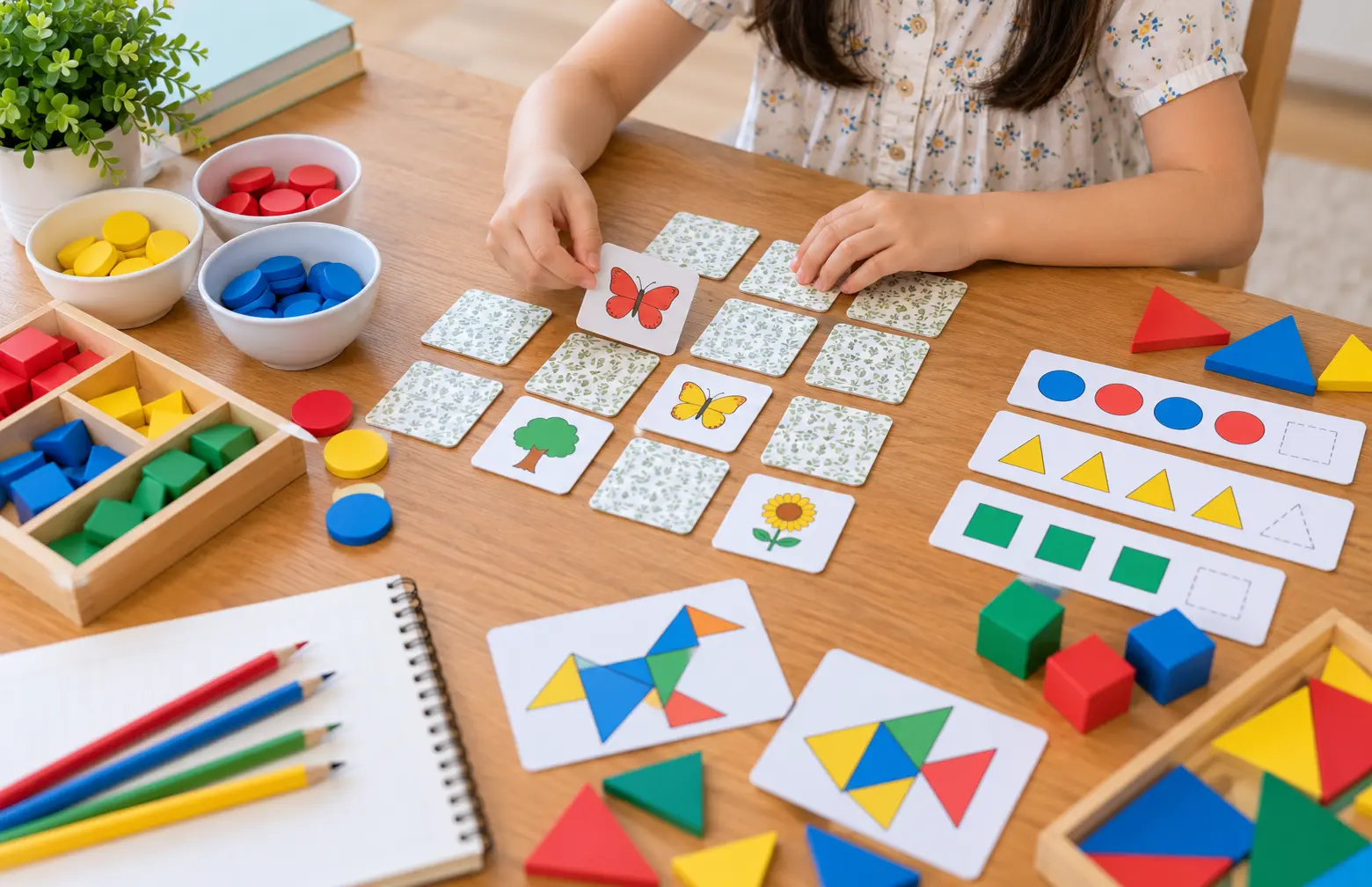
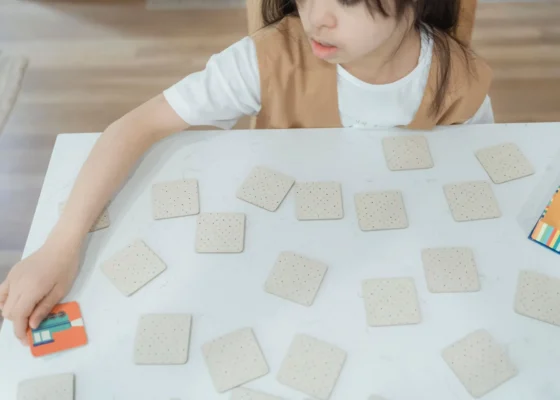
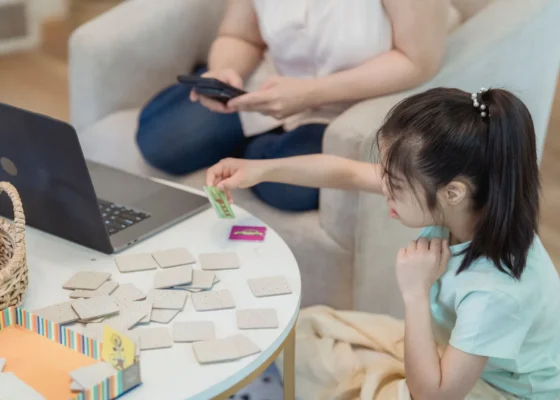
1. Memory Matching Cards
Skills practised: Visual memory and attention
Materials: Four to twelve pairs of matching picture cards.
How to play:
Place the cards face down on a table.
Ask your child to turn over two cards.
If they match, keep the pair. Otherwise, turn them face down again.
Continue until all matching pairs have been found.
Adjust the difficulty: Younger children can begin with four pairs. Older children can use more cards or try remembering the locations after a brief preview.
2. Remember and Repeat
Skills practised: Working memory and sequencing
Materials: None.
How to play:
Say a short sequence of colours, numbers or familiar objects.
Ask your child to repeat the sequence in the same order.
Begin with two or three items.
Increase the length gradually if the child is comfortable.
For a movement-based variation, demonstrate actions such as clap, tap the table and raise both hands.
Your child then repeats the movements in order.
Adjust the difficulty: Older children can try repeating short number sequences backwards.
Avoid making sequences so long that the activity becomes discouraging.
3. Sorting With Changing Rules
Skills practised: Cognitive flexibility and attention
Materials: Coloured blocks, cards or household objects.
How to play:
Ask your child to sort objects according to colour.
After completing the first round, explain a new rule.
Ask them to sort the same objects according to shape or size.
Discuss what changed between the two rounds.
Adjust the difficulty: Younger children can work with two colours and two shapes. Older children can sort using combinations of characteristics.
This activity offers opportunities to practise responding when task requirements change.
4. Spot the Difference
Skills practised: Visual attention and observation
Materials: Two similar pictures containing several differences.
How to play:
Place both pictures side by side.
Ask your child to look for differences.
Encourage them to examine one section at a time.
Review the differences together when finished.
Adjust the difficulty: Begin with three obvious differences before introducing more detailed pictures.
For older students, encourage a systematic search strategy, such as checking from left to right.
The focus should be careful observation rather than speed.
5. Sequence the Story
Skills practised: Sequencing, reasoning and verbal explanation
Materials: Three to six picture cards showing stages of an activity or story.
How to play:
Shuffle the picture cards.
Ask your child to arrange them in a logical order.
Invite them to explain what happens first, next and last.
Discuss whether another order could make sense.
Adjust the difficulty: Younger children can sequence familiar routines, such as brushing their teeth.
Older children can work with more complex stories involving cause and effect.
This activity can also create opportunities to practise English sentence construction and storytelling. For children preparing for the PSLE, parents can explore our guide on how to improve PSLE English composition writing for more targeted writing support.
6. Logic and Pattern Puzzles
Skills practised: Reasoning and problem-solving
Materials: Coloured shapes, number cards or printed puzzles.
How to play:
Present a simple repeating pattern.
Ask your child to identify the missing item.
Invite them to explain the pattern.
Introduce a more challenging sequence when ready.
For example:
- Red → Blue → Red → Blue → ?
Older children can explore number patterns or puzzles involving more than one rule.
Adjust the difficulty: Start with repeating patterns before moving to number relationships.
Encourage your child to explain their reasoning, even when the answer is incorrect.
7. Plan and Complete a Mini Challenge
Skills practised: Planning, organisation and self-monitoring
Materials: Everyday household or school items.
How to play:
Choose a small project, such as packing a school bag or building a model.
Ask your child what materials they need.
Help them decide the order of the steps.
Let them complete the task.
Encourage them to check the finished result.
Adjust the difficulty: Younger children can follow a short visual checklist. Older children can plan a task more independently.
This activity connects planning practice to everyday responsibilities.
Parents interested in practical, hands-on learning approaches can also read our guide to kinesthetic learning and hands-on tuition in Singapore.
How to Adapt Brain Training Activities by Age
The same activity can be made easier or more challenging depending on the child.
These are general suggestions, not strict developmental benchmarks.
A child’s interests, confidence and individual learning needs are more important than their school level alone.
How Often Should Children Practise?
There is no universally established schedule that guarantees academic benefits from brain-training games. For home activities, parents can begin with short sessions of approximately five to ten minutes and adjust according to the child’s interest and comfort.
A simple routine might involve a memory game on one day, a logic puzzle on another and a planning challenge over the weekend. Variety can help maintain interest without making the activities feel like additional homework.
If your child becomes frustrated or tired, reduce the difficulty, offer a break or choose another activity.
Consistency and enjoyment are more useful goals than trying to achieve increasingly high game scores.
Can Brain Training Activities Improve School Performance?
However, research has not consistently shown that these improvements transfer to broader academic achievement. For example, becoming better at remembering picture cards does not automatically improve reading comprehension.
Parents can make activities more educationally relevant by connecting them to school subjects. Story sequencing can provide opportunities to practise narrative organisation, while number patterns can encourage mathematical reasoning.
Nevertheless, children still require direct teaching and guided practice to develop subject knowledge. For example, solving pattern puzzles is different from interpreting the language and choosing appropriate methods for Mathematics word problems. Our article on why students struggle with PSLE Math problem sums explores some of the challenges involved in applying mathematical knowledge.
Brain-training activities are best viewed as supplementary experiences rather than academic interventions on their own.
Brain Training Activities for Children With Special Educational Needs
Children with Special Educational Needs (SEN) can participate in many of these activities when appropriate adaptations are provided.
Some children may benefit from shorter instructions, visual examples, fewer materials or additional processing time.
For children with ADHD, clear rules and manageable activity lengths may help make participation easier.
Parents interested in the evidence surrounding cognitive exercises can explore our Brain Training for ADHD guide.
For more practical academic teaching approaches, our existing article on ADHD tuition in Singapore discusses strategies that may help children engage with learning tasks.
For autistic children or children with dyslexia, adaptations should reflect individual preferences and learning needs rather than assumptions based on a diagnosis.
These activities are not substitutes for appropriate educational interventions or professional support.